
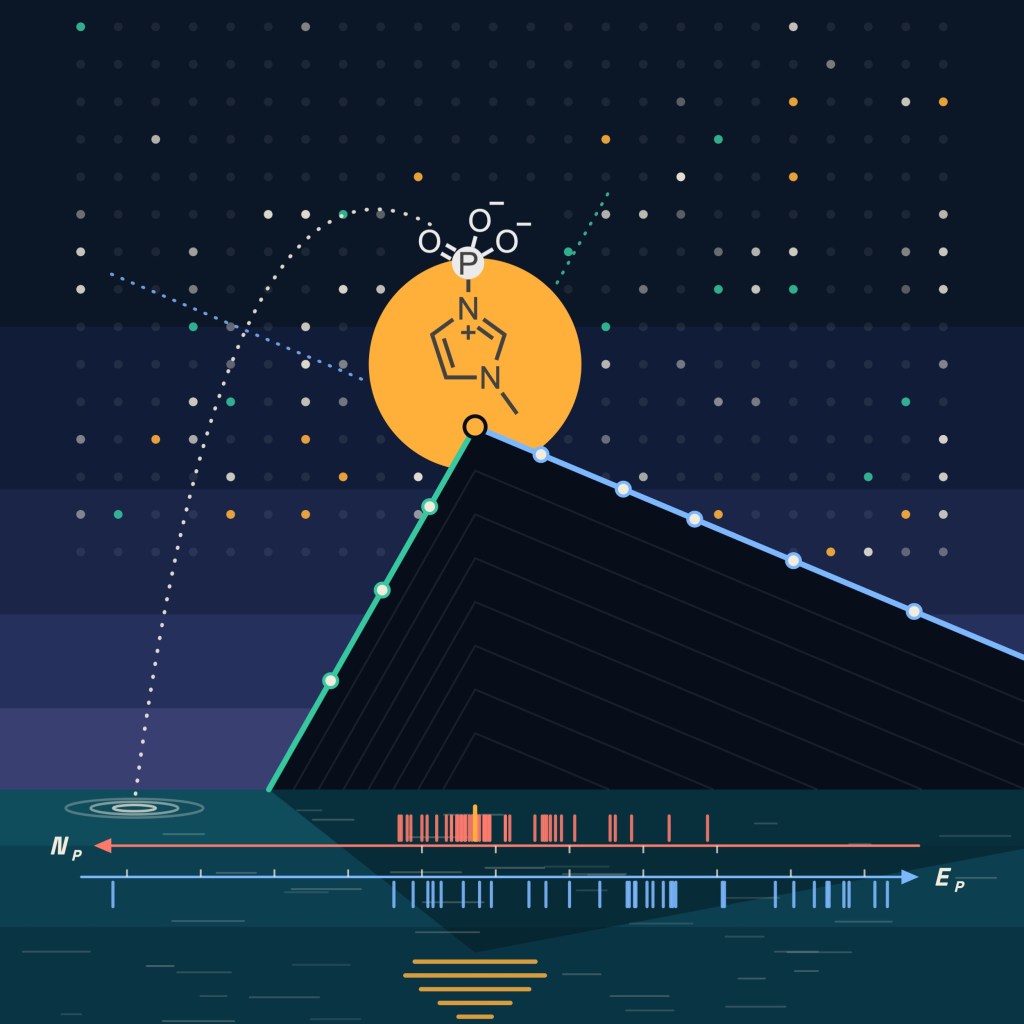
We are very happy to share that our paper “A Unified Reactivity Scale Predicts Nonenzymatic Phosphoryl Transfer and Nucleophilic Catalysis in Water” has just been published in the Journal of the American Chemical Society. The work was carried out by Nat Schürmann and Yanyan Fei.
In short: we measured 11,520 phosphoryl transfer reactions in water and condensed them into a single reactivity scale covering 34 phosphorylating agents and 45 nucleophiles. With it, we can predict rate constants for all 1,530 combinations of these compounds, spanning 14 orders of magnitude in reactivity. We then used these predictions to ask which catalysts are best suited for nonenzymatic phosphoryl transfer and arrived at a kinetic rationale for why enzymes so often rely on histidine.
From a seed project to a JACS paper
This project started small. A seed-funding project of the Excellence Cluster ORIGINS allowed us to purchase our first liquid-handling robot. That robot, in turn, led to a scholarship from the Daimler and Benz Foundation, which supported the project financially thereafter.
All of the work was done in two consecutive master’s theses. Yanyan Fei went first: he developed the high-throughput kinetic workflow, implemented the kinetic analysis, and worked out which substrates are suitable for this kind of study. Nat Schürmann then took over, refined the analysis, generated the full dataset, and established the predictive model. Just in time for the revisions, Nat returned to the lab as a PhD candidate, so they could bring the paper over the finish line themselves. Yanyan has since moved on and now works at Kingfa Science & Technology.
The start was much harder than we had expected. We spent the first months trying to reproduce kinetics reported in the old literature and really struggled to translate them into a 384-well plate format. This came as a surprise, as we had thought it would be far more straightforward. In hindsight, it fits a pattern: in most of our projects, assay optimization is the most time-consuming step.
Why phosphoryl transfer?
The overarching idea is the same as in our recent publication in Angewandte Chemie Novit: use high-throughput kinetics to generate a large, consistent kinetic dataset, and then exploit it to train a predictive model. This time, however, we wanted a model tailored to one specific application: phosphoryl transfer.
Phosphoryl transfer is arguably one of the most relevant reaction types in biochemistry. It is how ATP functions as the “energy currency” of the cell, and it has attracted considerable interest in the prebiotic and systems chemistry communities in recent years. Without enzymes, though, these reactions are intrinsically slow, and it is hard to tell in advance whether a given nucleophile and phosphorylating agent will react productively or whether the phosphorylating agent will simply hydrolyze.
So we asked two questions. Can we predict which combinations of phosphorylating agents and nucleophiles react well? And, since nucleophilic catalysis was likely a key way of enabling phosphoryl transfer before enzymes existed, which combinations of catalyst and phosphorylating agent maximize turnover?
11,520 kinetic measurements, and a lot of buffers
To build the dataset, we combined five phosphorylating agents with 28 nucleophiles (pyridines, aliphatic amines, azoles, thiols, and phenols) and varied both the nucleophile concentration and the pH for every pair. That adds up to 11,520 kinetic experiments, pipetted by the robot into 384-well plates and followed by UV/Vis in plate readers.
The kinetics themselves were not what took the most time. We used every nucleophile as the buffer for its own reaction, which means that for around 30 different compounds, Nat and Yanyan typically prepared four buffer solutions each. Unlike the kinetic measurements, this was entirely manual work.
The other challenge is that these reactions are slow. We followed most of them for one to seven days, so even with 384 reactions running in parallel, measuring the 30 plates took around three months and kept several plate readers occupied almost continuously. Measurements over such long times bring their own problems, such as evaporation or small bubbles, and extracting reliable numbers from this inherently noisy data was a project in itself.
In the end, 8,856 kinetic traces gave usable rate constants. For each pair of substrates, the 48 to 96 individual measurements were then condensed into mechanism-specific second-order rate constants, which we obtained for 102 combinations of nucleophiles and phosphorylating agents.
Why a linear free-energy relationship, in times of machine learning?
Our predictive model is a linear free-energy relationship (LFER). It describes each phosphorylating agent by one electrophilicity parameter (E) and each nucleophile by a nucleophilicity parameter (N) and a sensitivity parameter (s):
In times of machine learning, this may look like an odd choice. But an LFER is a statistical approach built for exactly this problem, predicting the rate constant for a combination of two reaction partners, and it has some real strengths.
First, the predictions are powered by our experimental data alone. No descriptors, computations, or other external parameterization are needed.
Second, it is very data-efficient. Parametrizing the scale needs only max(3 × N(Nu), 2 × N(E)) rate constants, where N(Nu) is the number of nucleophiles, N(E) is the number of electrophiles, and max() returns whichever of the two numbers is larger. The required effort therefore grows linearly with the number of compounds, while the number of predictable combinations grows with their product. For a large dataset this pays off: our core parametrization rests on 187 rate constants, from our own measurements and from the literature. Extended by a few correlations, the scale now predicts all 1,530 combinations of 34 phosphorylating agents and 45 nucleophiles.
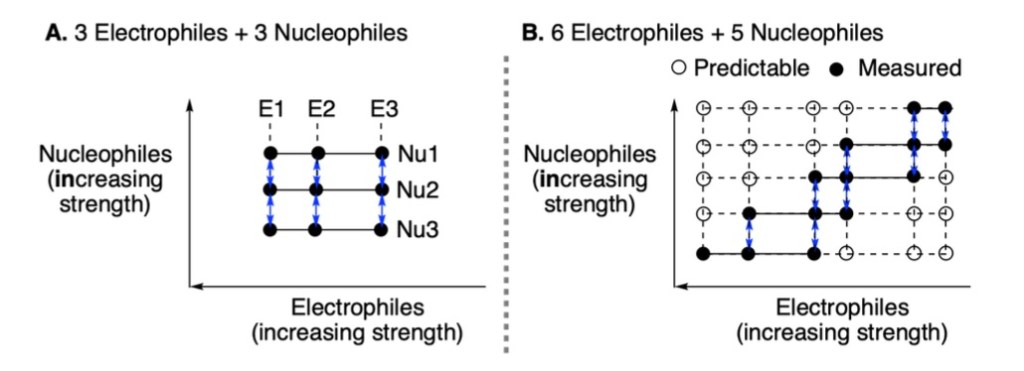
Third, we do not fly blind. Adopting a Bayesian bootstrapping protocol by Jonny Proppe, we obtain a 95% confidence interval for every single prediction. For 88% of all combinations, the predicted rate constant is expected to be accurate within a factor of about 3, and for 97% within one order of magnitude.
A nice side effect: because rate constants are intrinsic properties of a reaction, we could merge our data with 176 rate constants from decades of literature, including the classic studies by Jencks, Kirby, and Herschlag. Previously disconnected datasets now sit on one common scale.
Volcano plots for nucleophilic catalysis
The part I am personally most excited about is the use of molecular volcano plots. The concept originally comes from heterogeneous catalysis and was only recently brought into homogeneous catalysis. A volcano plot relates the activity of a multistep catalytic cycle to a single descriptor of the catalyst, and the best catalyst sits at the top, where the competing steps are balanced.
This fits nucleophilic catalysis of phosphoryl transfer perfectly, because every step of the catalytic cycle is itself a phosphoryl transfer, and our LFER can predict all of them. An electron-rich catalyst is phosphorylated quickly, but then holds on to the phosphate too tightly. An electron-poor catalyst releases it readily, but is slow to pick it up in the first place. Turnover is highest where the two rates match.
We tested this for monoamidophosphate, a popular prebiotic phosphorylating agent, with a series of pyridines as catalysts. The model predicts the optimum close to 3-methylpyridine and pyridine itself, and experimentally we indeed observed the largest turnover with 3-methylpyridine.
The same analysis can be applied to ATP. Here, the predicted optimal catalysts are imidazole and N-methylimidazole. Imidazole is the side chain of histidine, and phosphohistidine intermediates are common in enzymes that transfer phosphate from ATP. The slow rates did not allow us to test this prediction experimentally, but it suggests that nature’s choice of histidine may reflect a kinetic preference that is already encoded in the nonenzymatic chemistry.
As far as we know, this level of analysis is a first in prebiotic and systems chemistry.
Looking back and forward
This project advances my vision of data-driven, mechanistic prebiotic chemistry. Instead of screening for a hit and stopping there, we characterize the underlying kinetic and mechanistic space of a reaction, in this case, phosphoryl transfer. That allows us to define the scope and limitations of the reaction quantitatively, and to say which combinations of substrates and catalysts were chemically privileged before enzymes emerged.
All raw kinetic data and analysis scripts are openly available on GitHub and Zenodo. However, to use the scale and predict the rate constant for a phosphorylation transfer reaction, you simply need to add up the parameters in Figure 5 of the paper, which does not even require a computer.
Huge congratulations to Nat and Yanyan, who turned a new robot and an idea into a complete story. We thank the Daimler and Benz Foundation and the Excellence Cluster ORIGINS for making this project possible.


Leave a Reply