
It’s a huge milestone for the MayerLab: our first fully independent paper, featuring the work of Stefan Kuffer, has been published in Angewandte Chemie Novit!
In our work, “High-Throughput Kinetics Enable Predicting Reactivity Across Mechanisms of Acid/Base Catalysis in Water,” we combine high-throughput experimentation, physical-organic chemistry, and data science to take a first step toward one of our broader research goals: predicting chemical reactivity and catalysis in water. The study establishes a high-throughput kinetic workflow and uses it to generate a dataset of 6,889 experimentally determined rate constants.
We are particularly excited that the work was selected by the Scientific Advisory Committee for publication in Angewandte Chemie Novit. The editorial summary highlights the combination of mechanistic understanding, high-throughput experimentation, and data science into a transferable workflow for understanding reactivity in water.
For a broader introduction to the science and why predicting reactions in water matters, the TUM School of Natural Sciences has also published a feature about our work: “High-Throughput Kinetics Makes Chemical Reactivity in Water Predictable”
Behind the paper: bringing high-throughput experimentation to physical-organic chemistry
For us, this publication is more than a single study. It marks the first major milestone of Robert’s Emmy Noether project and an important first step toward establishing high-throughput physical-organic chemistry as one of the central research directions of our lab.
The project began in January 2024, initially with Robert working on the idea and experimental setup. It was then taken over and developed by Stefan Kuffer, the first PhD student to join the MayerLab, who turned the initial concept into the high-throughput kinetic methodology and dataset presented in the paper.
At its heart, this is a methodology project. Measuring reaction kinetics is one of the most direct ways of understanding chemical reactivity, yet classical kinetic experiments are often painstakingly slow. This becomes a particular problem in water, where several mechanisms of acid and base catalysis can operate simultaneously and where reaction rates depend on multiple interconnected parameters, including pH, catalyst identity, and concentration. Fully mapping this space can therefore require hundreds of kinetic measurements even for a single pair of substrates.
Our question was therefore: Can we bring the logic of high-throughput experimentation to kinetic measurements—and then use the resulting data to actually understand and predict reactivity?
As a model system, we chose the addition of urea to aldehydes. This seemingly simple reaction is an ideal playground because it can proceed through several different pathways of acid and base catalysis. That complexity allowed us to put both the experimental methodology and our subsequent analysis to the test. Using liquid-handling robotics together with continuous UV monitoring, we could systematically explore reaction conditions and ultimately assemble a dataset of 6,889 high-quality kinetic measurements across ten carbonyl compounds.
From lots of data to chemical understanding
Generating thousands of measurements is one challenge. Turning those measurements into something we can interpret as chemists is another one.
We therefore explored two complementary ways of extracting predictive information from the dataset. First, we developed a mechanistically guided analysis rooted in physical-organic chemistry. This allows us not only to predict absolute rate constants for a particular substrate across reaction conditions, but also to resolve how much the individual mechanisms of acid and base catalysis contribute at different points in this multidimensional reaction space.
Second, once multiple substrates enter the picture, we explored machine-learning regression. By combining the experimental reaction parameters with molecular descriptors, we could build models that predict absolute reaction rates across substrates and reaction conditions. In other words, the two approaches provide complementary views: mechanistic modeling gives us chemical interpretability and resolves the underlying catalytic pathways, while machine learning helps us connect reactivity across a larger experimental dataset.
One result that particularly surprised us was that reactivity itself is not conserved across mechanisms. A substrate that is comparatively more reactive under acid catalysis can become less reactive under base catalysis, and vice versa. In our dataset, for example, aliphatic aldehydes were more reactive than the investigated aromatic aldehydes under acid catalysis, while the trend reversed under base catalysis.
This has an important consequence for how we think about reactivity in water. Measuring a reaction at only a single condition (at one pH, for example) gives an apparent rate constant that can contain contributions from several mechanisms operating in parallel. Such a measurement, therefore, does not necessarily provide a transferable measure of intrinsic reactivity. To understand and ultimately predict aqueous reactivity, we need to account for how the underlying mechanisms change across the reaction space.
That is precisely the direction we want to pursue: combining kinetics, automation, mechanistic physical-organic chemistry, and data science to build quantitative pictures of increasingly complex reaction networks in water.
And a cover to go with it!
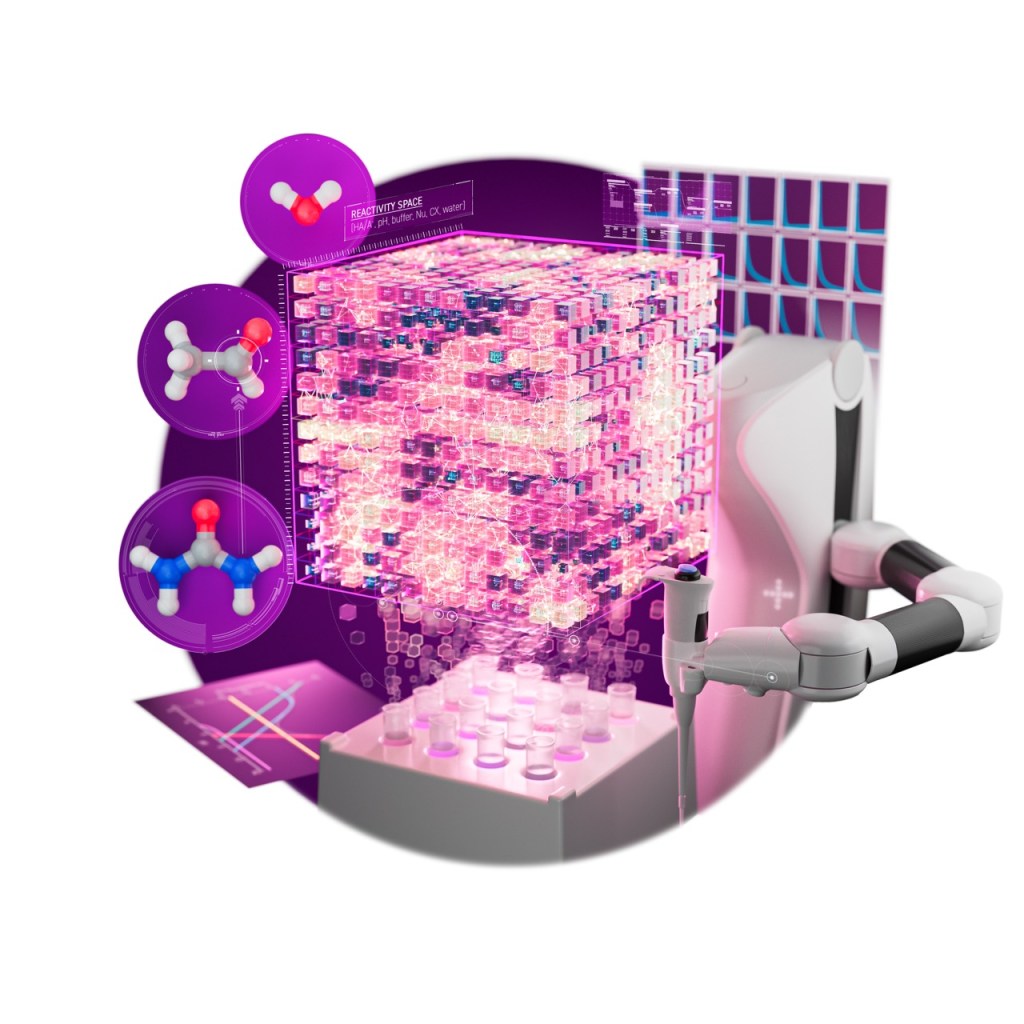
We were also thrilled that our work was featured on one of the supplemental covers of this issue of Angewandte Chemie Novit, with artwork designed by Jo Richers.
The artwork captures the idea behind the project: a glowing hypercube represents the multidimensional reactivity landscape created by competing mechanisms of acid/base catalysis. A robotic platform maps this landscape experimentally through high-throughput kinetic measurements, while mechanistic analysis and machine learning transform those measurements into quantitative models that resolve catalytic pathways and predict reactivity.
It is a fitting visualization of what we hope to achieve with this research program: mapping complex chemical reactivity experimentally and turning those maps into predictive chemical understanding.
Looking back and forward
Finally, this work would not have been possible without the people and institutions who supported us along the way.
A huge thank you goes to Job Boekhoven, who hosted us during the first two years of this project and generously allowed us to kick-start this research using the resources of his group. We are also grateful for financial support from the Fonds der Chemischen Industrie and the Deutsche Forschungsgemeinschaft (DFG) through the Emmy Noether Programme.
And, of course, thank you to everyone in the MayerLab who contributed ideas, discussions, troubleshooting, and enthusiasm along the way; and especially to Stefan for taking this project from its beginnings to our lab’s first major independent publication.
We are incredibly excited to see this first piece of our high-throughput physical-organic chemistry program out in the world – and even more excited about where we can take it next.


Leave a Reply