
2025 marked the second year of the Mayer Lab at TUM. With the generous support of the Boekhoven team in hosting us, the lab has continued to grow steadily while exploring the synergy of automation, computation, and organic chemistry. Over the course of the year, three students completed or began their Master’s thesis projects (Yanyan Fei, Felix Söhgen, and Natalie Schürmann), four students joined us for their Forschungspraktikum (Natalie Schürmann, Elena Bittner, Manuel Reichel, and Maximilian Lehner), and in November we were happy to welcome Felix back to the team as a PhD student.

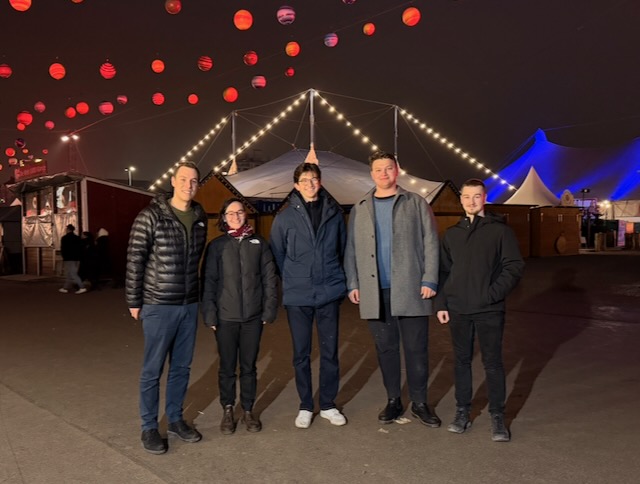
Teaching also became an important pillar of our activities in 2025. Robert completed the first full round of his lecture course on Physical Organic Chemistry and launched the second iteration in October. Notably, most of the students who joined the lab this year had previously attended the course, underscoring the role of teaching as a gateway.
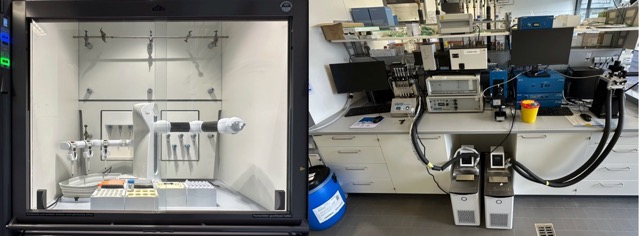
A major milestone in 2025 was the start of the Emmy Noether project, alongside several smaller initiatives supported by the Daimler and Benz Foundation and the Bavarian Academy of Sciences and Humanities (BAdW). If you are interested, here you can watch a video introducing the new members of the BAdW, including a sneak-peak into our lab. While the first research outputs from these projects are expected in 2026, their immediate impact has already been felt in the lab through a significant expansion of our experimental capabilities. We installed a brand-new stopped-flow system, upgraded our existing one, tripled the number of plate readers available for kinetic measurements, and added a range of smaller dedicated instruments. Together, these investments substantially strengthen our ability to conduct high-throughput mechanistic studies in organic chemistry.
In terms of publications, 2025 saw five research articles and one review added to the Mayer Lab’s record. These works were primarily collaborative efforts focused on reaction mechanism elucidation, often leveraging computational chemistry. At the same time, several projects originating within the lab have now reached the writing and finalization stage, setting the stage for exciting first in-house publications in 2026.
The year also included a number of scientific exchanges and conference highlights. Robert attended the Gordon Research Conference on Physical Organic Chemistry, while Stefan and Robert participated in the ESOR conference in Padova, where Stefan got the prize for the best poster. In addition, Robert took part in meetings of collaborative research centers and excellence clusters, including CRC 392 and the Origins Excellence Cluster, further strengthening existing collaborations and initiating new ones.
Looking ahead, 2026 promises further growth, with an expanding team and an increasingly diverse portfolio of research projects. Adding to this momentum, Robert was appointed Professor at TUM in December 2025—a development that will bring several exciting changes for the lab in the coming year. We are grateful to everyone who contributed to making 2025 such a productive and formative year and look forward to what lies ahead.

 Mayer lab at Technische Universität München
Leave a comment